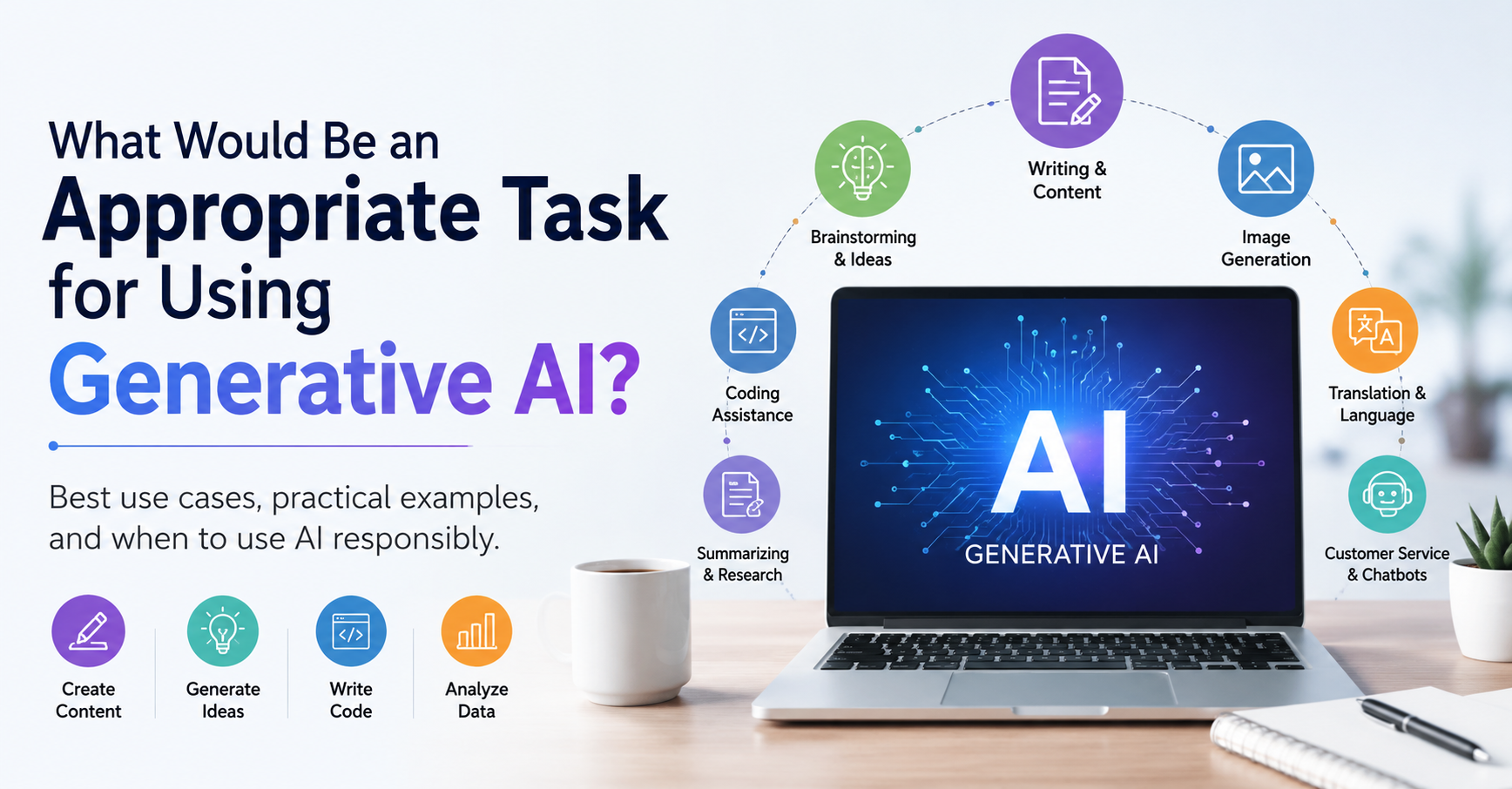
While generative AI can be used to accomplish a wide variety of tasks, it’s not a tool for all of them. So, what should be the task with an appropriate use of generative AI? Generally speaking, tasks that are related with creating, organizing, transforming, or developing content are suitable for AI support.
For instance, you can brainstorm ideas, write an email, summarize a lengthy document, outline an article, brainstorm image concepts, translate text, or even seek assistance with understanding a programming challenge.
The secret is to consider generative AI as an AI-assisted work tool, not a replacement for human thinking. The ideal scenario is when AI can take care of repetitive or creative support functions, and a human can give context, judgement, fact checking, and final approval.
This guide discusses tasks that are suitable for generative AI, where it can actually help, and where it’s best to be cautious.
What is Generative AI?
Generative AI is a type of artificial intelligence designed to create new content based on instructions or prompts provided by a user.
Generative AI can generate content like:
- Written text
- Images
- Computer code
- Audio
- Video
- Presentations
- Summaries
- Ideas and concepts
Examples of generative AI applications include AI writing tools, image generators, coding assistants, and AI-powered chatbots.
For example, someone could use a generative AI to generate a first draft for a blog post. AI image generation can be utilized by a designer to brainstorm visual ideas. An AI assistant could be asked by a programmer to provide an explanation for an error in the program.
In each instance, the information is created or modified by AI but the user is still responsible for determining the validity, suitability, and usefulness of the output.
What are the right tasks for Generative AI?
AI doesn’t work equally well for all tasks. Typically, the use of generative AI is suited to a few types of processes.
1. The task is to create or transform content.
Generative AI is especially helpful when creating something new or modifying information.
Examples include:
- Writing a first draft
- Rewriting text
- Summarizing information
- Creating an outline
- Generating ideas
- Developing marketing copy
- Creating visual concepts
2. The task is accelerated by 2x
AI can assist in minimizing repetitive or time-consuming tasks.
For instance, if you begin an e-mail from a blank page, you can give the key points to Artificial Intelligence and it will generate a professional version that you can then review.
3. It is a task that can be reviewed by humans.
Generative AI is most effective when it produces something that a human could review prior to use.
This is especially crucial for material that includes details, delicate information, legal compliance, monetary choices, or expert suggestions.
4. The task is not dependent on AI to make the decision.
AI can assist in decision making by structuring information or by providing options. However, tasks with serious consequences should be kept largely under human control.
What would be a fitting task for the use of Generative AI?
Generative AI can be used for a variety of suitable tasks in personal, educational, and professional contexts. Here are some of the most practical examples.
1. Writing and Brainstorming
A common use case for generative AI is to overcome the blank page problem.
AI can assist with:
- Brainstorming blog topics
- Generating content ideas
- Suggesting headlines
- Creating social media concepts
- Developing campaign ideas
- Writing under various angles
- The structure of an article can be improved by:
A content marketer might use an AI tool to brainstorm 20 blog post ideas on a given topic in a particular industry. The marketer can then pick out the best ideas and expand them.
The key is that AI is a starting point. Human experience will still be required to choose most relevant and original ideas.
2. The ability to summarize and rewrite information.
Generative AI can be helpful in simplifying complex or lengthy information.
Appropriate tasks include:
- Summarizing meeting notes
- Simplifying technical explanations
- Restructuring and rephrasing text for an alternative audience.
- How to convert long documents into key points.
- Creating executive summaries
- Converting paragraphs into bullet points
Now imagine that you have to give a 20 page report before a meeting. Using an AI tool, you can get a shorter summary of the information, and find important topics faster.
The original document, however, should still be available for reference particularly if important details might be missed out in summarizing.
3. Creating Marketing Content
Generative AI can also be helpful in marketing, for example, by generating product descriptions.
AI can be applied to business in many ways, such as:
- Blog post drafts
- Social media captions
- Product descriptions
- Email campaign ideas
- Advertisement concepts
- Content calendars
- SEO content outlines
- Marketing campaign brainstorming
A company might, say, share details of a new product and request AI to generate a number of promotional messages for various audiences.
Finally, a marketing professional should check the content for accuracy, a consistent brand voice and for promises that are too good to be true.
4. Creating Ideas & Content Outlines
One of the hardest things for a project is knowing where to begin.
Generative AI can make contributions to the development of:
- Blog outlines
- Presentation structures
- Project ideas
- Business brainstorming lists
- Video concepts
- Story ideas
- Research questions
For instance, if a student is creating a presentation on climate change, they might prompt AI to provide a logical structure that includes topics related to causes, effects, solutions, and examples of climate change in the real world.
The student can then make a final presentation based on information that they have found independently and verified.
5. Communicating through writing and emailing.
AI can help to save time on repetitive communication.
Tasks suitable include drafting:
- Professional emails
- Meeting agendas
- Internal announcements
- Business proposals
- Reports
- Project updates
- Customer responses
For instance, you might give AI three points and instruct it to convert these into a concise and professional email.
This is especially helpful for clarity and structure but users should always verify names, dates, numbers, attachments and sensitive information prior to sending the message.
6. Creating images and visual concepts.
In the initial phase of the creative process, AI image generation can be helpful.
Possible applications include:
- Creating concept art
- Developing campaign visuals
- Exploring design ideas
- Generating illustrations
- Creating presentation graphics
- Visualizing creative concepts
A marketing team may come up with a number of different visual ideas before they reach a creative conclusion for a campaign, for instance.
While AI-generated images can help accelerate the ideation process, users need to be mindful of copyright, licensing guidelines, brand needs, and the risk of misleading or manipulated images.
7. Coding Assistance
One other area where generative AI can be helpful is assisting software developers and individuals learning programming.
Common uses include:
- Explaining code
- Suggesting code snippets
- Identifying potential errors
- Translating programs from one programming language to another
- Generating documentation
- Explaining technical concepts
- Creating test cases
For instance, if a developer encounters a new error message, they can request an explanation from an AI coding assistant about what might be causing the error and recommend ways to debug it.
But, code generated should always be reviewed and tested. While AI can generate code, it may not be secure, efficient, up-to-date, or accurate, and human expertise is still crucial.
8. Research Support and Information Organization
Generative AI can facilitate the organization of information and streamline research processes.
Useful tasks include:
- Creating research outlines
- Organizing notes
- Generating questions
- Summarizing provided documents
- Comparing concepts
- Categorizing information
- Brainstorming ideas that may need to be explored further
For instance, a researcher might be able to use AI tools to categorize the notes that they’ve taken from various documents.
But AI should not be considered a source of facts without any doubts. When checking for important information, it is worth checking against trustworthy primary or authoritative sources.
9. Translation and Language Assistance
Generative AI can help those who work in multiple languages.
Suitable applications include:
- Translating general text
- Improving grammar
- Rewriting unclear sentences
- Adjusting tone
- Simplifying language
- Using a new language
AI translation can be a great help for daily communication.
When legal, medical, governmental or extremely sensitive documents are involved, professional human translation might be more suitable as subtle nuances in the text can make all the difference.
10. Creating Educational Materials
Generative AI can be used to assist teachers, students, and trainers in learning.
Examples include:
- Creating practice questions
- Developing quizzes
- Generating lesson outlines
- Explaining difficult concepts
- Creating study guides
- Developing examples
- Differentiating explanations for various levels of understanding
For instance, a teacher could use AI to break down a challenging scientific concept into simpler terms and then use that explanation as the basis for a discussion in the classroom.
The teaching content should still be checked for correctness and appropriateness to the age group.
11. Data Interpretation and Analysis Support
Generative AI can be an analytical assistant that assists users in understanding and working with data.
Possible tasks include:
- Describe the trends that exist in a set of data.
- Suggesting questions to investigate
- Helping interpret charts
- Summarizing findings
- Recognizing patterns to further examine
- Explaining statistical concepts
A business analyst might assist in deciphering the meaning of a sales report with the aid of AI.
But AI’s interpretations shouldn’t be taken at face value. Any important business, financial or scientific decisions should be substantiated by proper analytical processes and the opinions of experts.
12. Games Design and Creation.14. Visual Arts and Design.
When used within defined limits, generative AI can be suitable for customer service.
Potential applications include:
- Frequently asked questions with answers.
- Providing users with instructions on simple procedures
- Giving information from approved knowledge bases
- Creating customer support answers
- Assigning complicated queries to manned agents
For instance, a chatbot can answer a customer’s query regarding the business hours, or provide instructions on a typical procedure.
Further, more complex or sensitive issues should be raised at a human level.
There are instances where Generative AI might not be suitable for tasks.
It is just as vital to know when not to use generative AI as it is to know what it can do.
AI might not be suitable for tasks that involve:
High-stakes professional judgment
The need for qualified professionals and reliable evidence is vital in making important medical diagnoses, legal decisions, and other decisions.
Guaranteed accuracy
Generative AI might generate false information or misinterpret a user’s context. It should not be regarded as a dogma.
Data that is highly sensitive personal information.
Users should take care when inputting confidential details, personal information, passwords, monetary information, or company information that is proprietary to the user when utilizing AI software programs, unless the software program is properly approved and secured.
Choices that have significant repercussions.
While AI can aid in decision-making, it must be carefully monitored by humans when decisions impact the rights, safety, employment, education, or access to necessary services.
How to Decide When to Use Generative AI
When in doubt about a task, consider these questions:
1. Does the task involve primarily the creation, transformation or organization of information?
If yes, AI can be helpful.
2. Is the outcome easily readable by people?
Generally, AI is better if the output can be verified prior to its use.
3. What would happen if the AI is wrong?
When the error has relatively small consequences, AI can be seen as OK. When an error might cause significant damage, extra precautions are required.
4. Is the task sensitive information?
If it does, consider your organization’s privacy policies and the security of the AI system before sharing any data.
5. Does the job call for professional skills?
When special expertise is required, rely on AI as an assistant, not a substitute for the expert.
6. Is there meaningful time that can be saved and/or process improvement using AI?
If AI doesn’t offer a definite advantage, there might not be a big reason to use it.
A useful rule is:
Leverage generative AI to speed up work, not to get rid of responsibility.
The responsible use of Generative AI is required.
The most effective way to leverage generative AI is to use technology and be responsible.
Fact-check AI-generated content
It’s possible to create content with AI that sounds like it’s confident but isn’t. Check out key facts, statistics, quotations, names, dates and references before using or publishing.
Protect privacy
Do not share information that is confidential or personally identifying unless you are aware of how the system keeps it confidential and protected.
Watch for bias
AI systems may perpetuate biases in the data they are trained on, or generate outputs that disproportionately represent individuals or groups. Critically review outputs, particularly in sensitive situations.
Maintain transparency
In certain workplaces or organizations, individuals might need to acknowledge the use of AI to generate or significantly edit text. Abide by relevant policies and expectations.
Do not allow humans to take control
In high-stakes applications like healthcare, education, employment, finance, law enforcement, public services, and other critical fields, human oversight becomes particularly critical when AI is employed.
The Best Use Cases for Generative AI
The best applications of generative AI typically fall into one of a few general categories:
- Create – Develop text, graphics, concepts and programming.
- Transform – Rewrite, translate, summarize or simplify information.
- Organize – Arrange notes, ideas, documents and information.
- Assist – Provide assistance for research, coding, analysis, problem-solving.
- Automate – Assistance with repetitive tasks like customer service or regular correspondence.
- Explore – Brainstorm and brainstorm possibilities.
Let’s see the applications that illustrate the value of generative AI to various sectors. The best application of the technology is when it can augment human abilities rather than replace them.
Conclusion
So, what would be a suitable task to use generative AI on? The solution is for any task that AI can perform safely and in ways that create, transform, organize or explore information, and in which a human can review and improve the output.
Applications that might be appropriate include drafting, brainstorming, summarising, marketing writing, image generation, coding support, research organisation, general text translation, educational writing and customer service support.
However, generative AI tools must be used judiciously when accuracy, privacy, security, ethics or professional judgement are paramount.
The best answer is not to ask “Can AI do this task? Rather, ask “Can AI assist with this task, with a human still responsible for the result?” If the response is “yes”, then generative AI might be the right and useful tool.
Frequently Asked Questions
What can generative AI do that’s a good job for it?
Tasks usually involve brainstorming, writing and summarizing, helping to code, organizing information, assisting with routine customer service, and creating content.
What are the most impactful activities to use generative AI for?
The ideal task is typically one which entails repetitive work, content generation, idea production, information conversion, and initial creative investigation that can be checked by a human.
When is it inappropriate to use generative AI?
If it is a task that involves highly sensitive information, a very high-stakes decision, professional judgment, guaranteed accuracy or serious consequences if the AI gives an incorrect result, you should be careful.
Is it possible for generative AI to take the place of human workers?
While Generative AI can automate or support tasks in certain cases, it cannot replace human judgment in many instances. AI is best used in conjunction with human beings.
What are the responsible ways to employ generative AI in business?
Companies need to have clear policies on AI, safeguard sensitive data, verify critical outputs, check for bias, ensure human oversight, and outline tasks suitable and unsuitable for AI.
Can AI content be 100% accurate?
No. Generative AI can generate false or misleading information. Any important claims or information should be verified independently before publication or use for important decisions.