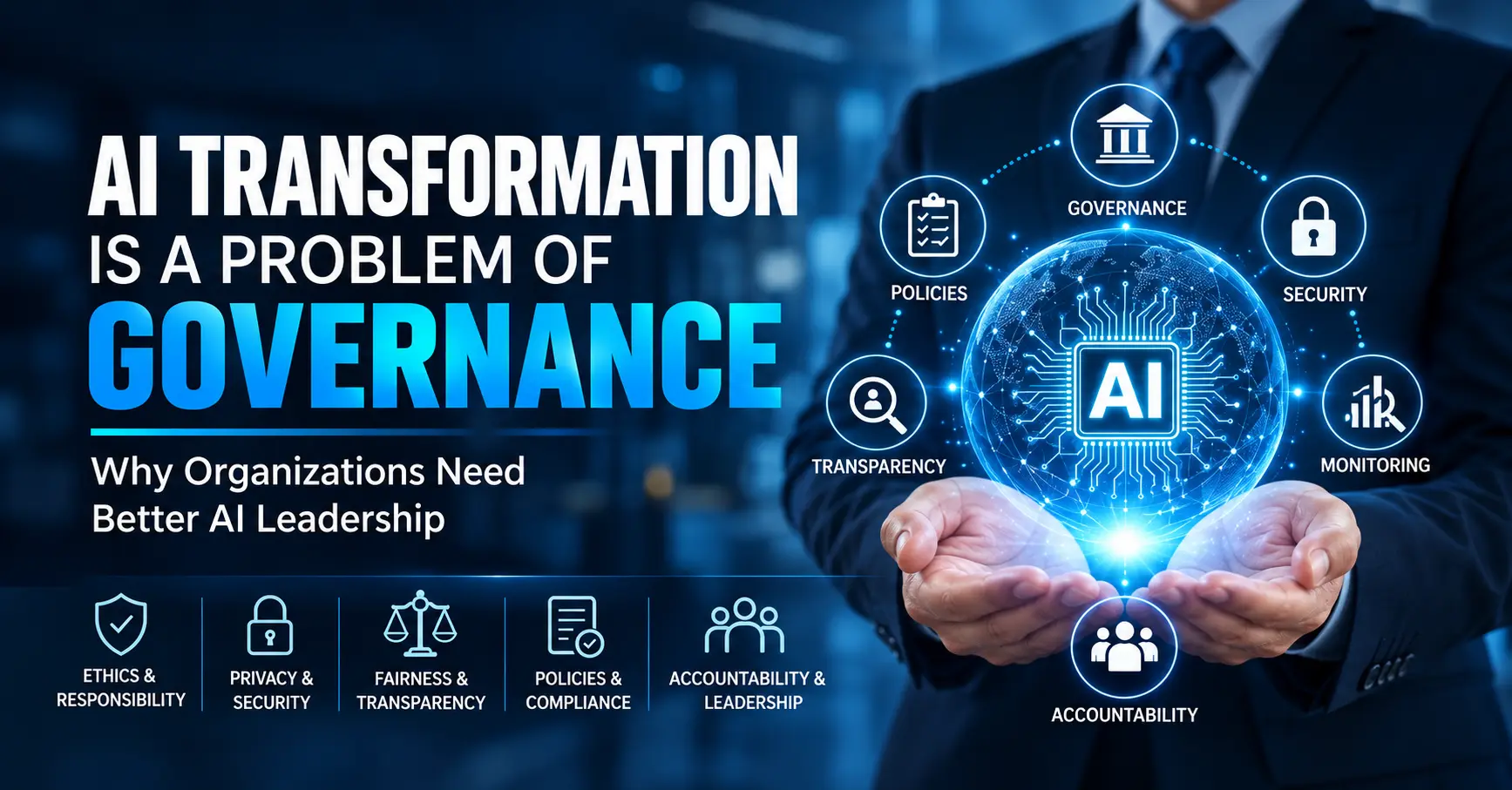
What does ‘AI transformation is a problem of governance’ mean?
The phrase means that the hardest part of adopting AI is not the technology. It is deciding who owns AI decisions, which data can be used, what risks are acceptable, and who answers when something goes wrong.
The idea spread widely on X in 2026 after [name of author] argued that [one-line summary of their point]. [Embed or link the original post here.]
A useful way to think about it: AI works like a mirror. It doesn’t create an organization’s weaknesses, it exposes them. A company with unclear goals, messy data ownership, or no accountability will see those problems appear faster and at larger scale once AI is involved. That is why the companies that succeed with AI are usually not the ones with the best models, but the ones with the clearest rules.
AI transformation is a problem of governance because most AI failures trace back to decisions about people, data and accountability, not to the algorithm. Three bodies of evidence point the same way.
1. The root causes of AI failure are organizational
RAND interviewed 65 experienced data scientists and engineers to find out why AI projects fail. Of the five root causes they identified, the most common was that business stakeholders misunderstand or miscommunicate what problem AI should solve. The second was a lack of the right data. Only one cause, applying AI to problems that are too hard, is mainly about the technology itself (RAND).
Unclear goals, unclear data ownership and unclear success criteria are all governance gaps. They are decided in leadership meetings, not in code.
2. Governance maturity predicts who scales
Schellman surveyed 525 US professionals at companies with 500+ employees in April and May 2026. The results show a large gap between confidence and readiness (Schellman, 2026):
| Finding | Share of organizations |
|---|---|
| Believe they could pass an AI compliance audit today | 74% |
| Have a formal AI acceptable use policy communicated to staff | 64% |
| Have a formal AI governance policy | 57% |
| Report AI governance regularly to the board or executive team | 54% |
| Have AI-specific incident response procedures | 44% |
| Describe their AI governance program as fully mature | 27% |
The most important number is the scaling gap. Organizations with mature governance had AI agents in production at a rate of 78%, compared with 22% for organizations still developing their programs. Respondents also credited governance with easier AI scaling (43%) and stronger regulatory readiness (49%).
Gartner sees the same pattern from the other side. It predicts that over 40% of agentic AI projects will be canceled by the end of 2027 because of escalating costs, unclear business value or inadequate risk controls (Gartner). Unclear value and weak risk controls are governance failures.
3. Real incidents were governance failures, not model failures
Air Canada’s chatbot. In 2024, a Canadian tribunal held Air Canada liable after its website chatbot gave a customer wrong information about bereavement fares. The airline argued the chatbot was responsible for its own answers. The tribunal rejected that and found Air Canada had not taken reasonable care to make sure the chatbot was accurate (Law360 Canada). The missing pieces were accountability and output monitoring.
Samsung’s source-code leak. In 2023, Samsung engineers uploaded internal source code and meeting notes to ChatGPT while doing their jobs. Samsung responded by banning generative AI tools on company devices while it built internal alternatives (Forbes). The missing piece was a data-use policy for employee AI tools.
In both cases the technology did what it was built to do. What failed was the absence of clear rules about ownership, data and oversight. That is the core argument of this guide: technology provides the capability, but governance decides whether the capability creates value or creates risk.
What is AI transformation?
AI transformation is the strategic integration of artificial intelligence into how an organization operates, decides, serves customers and creates value. It goes beyond buying an AI tool. It changes workflows, roles and the operating model itself.
The key distinction is between adoption and transformation:
| AI adoption | AI transformation | |
|---|---|---|
| Scope | One tool in one team | AI embedded across core processes |
| Example | Marketing uses an AI writing assistant | Customer service, underwriting and operations are redesigned around AI |
| Who decides | A team lead | Executive leadership |
| Governance need | A usage policy may be enough | Ownership, risk tiers, approvals, monitoring and audits |
Adoption can survive with light rules. Transformation cannot, because once AI influences pricing, hiring, credit or customer promises, every error becomes a business, legal or reputational event. The bigger the change, the bigger the governance question.
What is AI governance?
AI governance is the system of policies, roles, processes and controls an organization uses to manage AI across its full lifecycle, from the first idea to retirement. Its goal is not to stop AI. Its goal is to make AI use deliberate, measurable and accountable.
Good governance answers five questions for every significant AI system: what it is for, who owns it, what data it uses, what could go wrong, and how you will know it is still working. If a team can’t answer those five questions, the system isn’t ready for production.
The most widely used reference is the NIST AI Risk Management Framework, a voluntary framework built around four functions: Govern, Map, Measure and Manage. The six pillars below translate those functions into the areas an enterprise actually has to organize.
The six pillars of enterprise AI governance
A working AI governance program covers six areas. Weakness in any one of them is enough to stall a transformation.
1. Strategy and leadership
AI transformation needs a named executive owner and a clear answer to one question: what measurable business outcome should this AI produce? Without that, departments run duplicate pilots with inconsistent rules, which matches the leadership failures RAND identified.
Leadership should set the AI vision, investment priorities, risk appetite and who can approve what. Every significant AI initiative should have a target metric before it gets a budget.
2. Data governance
AI is only as reliable as the data it uses. Data governance defines who owns each dataset, how it is classified, who can access it and what may be sent to third-party AI services.
The Samsung incident shows why the last point matters. If employees don’t know that confidential code or customer data must not go into public AI tools, someone will eventually paste it in.
3. Risk management
Not every AI use case carries the same risk. A tool that summarizes internal meeting notes needs lighter controls than a system that screens job applicants or influences credit decisions.
Classify each use case by its impact on people, data sensitivity, level of automation, regulatory exposure and business criticality. Then match controls to the tier:
| Risk tier | Example | Governance response |
|---|---|---|
| Low | Summarizing internal documents | Acceptable-use policy and basic monitoring |
| Moderate | Suggested replies for support agents | Testing, owner approval and monitoring |
| High | Hiring or credit decision support | Formal risk assessment, human review of decisions, legal sign-off |
| Critical | AI affecting safety or fundamental rights | Specialist review, documented accountability, executive approval |
Adapt the tiers to your industry and jurisdiction. Under the EU AI Act, for example, recruitment and credit scoring are explicitly listed as high-risk categories.
4. Responsible and ethical AI
Responsible AI means checking how a system affects the people it touches, not just whether it is accurate. NIST lists the characteristics of trustworthy AI as valid and reliable, safe, secure and resilient, accountable and transparent, explainable and interpretable, privacy-enhanced, and fair with harmful bias managed.
A recruitment model trained on biased historical hiring data can be accurate and still unfair. So the governance question is never only “does the model work?” It is also “does it work appropriately for the people and decisions it affects?”
5. Human oversight and accountability
Automation does not remove responsibility. The Air Canada ruling made that explicit: the company stayed liable for what its chatbot said.
For every significant system, define in writing when a human must review an output, override a decision, escalate an incident or shut the system down. Most importantly, name one accountable business owner. Technical ownership alone is not enough.
6. Continuous monitoring and improvement
Governance does not end at launch. Data drifts, user behavior shifts, regulations change and new attack methods appear.
Monitor accuracy, bias indicators, security events, human override rates, user complaints and business outcomes. Set thresholds that automatically trigger a review. A useful rule: deploy once, monitor continuously, improve regularly.
A 7-step framework to build an AI governance program
These seven steps take an organization from scattered AI experiments to governed, scalable AI. They follow the AI lifecycle, so each step also tells you what to check at that stage of a system’s life.
Step 1: Build an AI inventory
You can’t govern AI you don’t know exists. List every AI system being built, bought, tested or used, including employees’ use of public generative AI tools.
For each entry, record the system name, business owner, purpose, model or vendor, data used, users, affected process, risk tier and status.
Step 2: Classify risk
Assign each system a risk tier using the table in the risk management pillar above. Score impact on people, data sensitivity, autonomy, regulatory exposure, security and business criticality.
The tier decides how much of steps 3 to 7 each system goes through. This keeps governance proportionate, so low-risk tools don’t wait weeks for approval.
Step 3: Assign ownership and set policies
Give every significant system one accountable business owner. Then publish policies covering approved tools, confidential and personal data, intellectual property, AI-generated content, human review and incident reporting.
Keep the acceptable-use policy short enough that employees will actually read it.
Step 4: Define approvals by tier
Match approval depth to risk:
- Low risk: department head approval.
- Moderate risk: technology and security review.
- High and critical risk: legal, compliance, risk, security and executive review.
Write down who can approve what, so teams know the path before they start building.
Step 5: Deploy with controls in place
Before a system goes live, confirm testing results, security controls, access permissions, documentation, human oversight points, an incident procedure and a performance baseline.
Treat launch day as the start of operational governance, not the end of the project.
Step 6: Monitor and audit
Track both technical performance and business impact. Accuracy can stay stable while user behavior or outcomes change, so you need both signals.
Schedule periodic audits of documentation, data use, access controls, incidents, human interventions and compliance. High-risk systems need more frequent reviews.
Step 7: Review, improve and retire
Update governance as new capabilities, risks and regulations appear. When a system is no longer needed, retire it deliberately: decide what happens to the model and its data, inform users, check dependent systems, keep required records and remove access.
Your first 90 days: an AI governance roadmap
You don’t need a year-long program to get control of AI. Most of the risk reduction comes from the first 90 days, if you sequence the work in three phases.
| Phase | Goal | Key actions | Done when |
|---|---|---|---|
| Days 1–30: See | Know what AI you have | Name an executive sponsor; survey every team for AI tools and projects; build the AI inventory; publish a one-page interim rule on what data must never go into public AI tools | Every production AI system and popular employee tool is listed with an owner |
| Days 31–60: Sort | Match control to risk | Assign a risk tier to each system; form a small governance committee; publish the acceptable-use policy; define approval paths per tier | Every system has a tier, and high-risk systems have a review date |
| Days 61–90: Steer | Make governance operational | Add monitoring and incident procedures for high-risk systems; train staff on the policy; set 3–5 KPIs; report status to leadership | Leadership sees a governance dashboard, and new AI projects follow the approval path by default |
After day 90, governance becomes a rhythm rather than a project: quarterly reviews, yearly audits of high-risk systems, and updates when regulations change.
A practical tip from the first phase: ask teams which AI tools they use “to save time”, not which “AI systems” they run. People rarely think of a browser extension or a meeting-notes bot as an AI system, but those are exactly the tools that move company data outside your control.
Who owns AI governance?
AI governance works best when accountability is shared across a few clear roles, with one executive owning the program. In many companies today it falls by default on IT: Schellman found that 37% of organizations say the CIO or head of IT is ultimately accountable when AI risks emerge.
IT alone can’t answer business, legal and ethical questions, so most mature programs spread the work like this:
| Role | Responsibility |
|---|---|
| Executive sponsor (CEO, COO or Chief AI Officer) | Sets AI strategy, risk appetite and budget; owns the program |
| AI governance committee | Cross-functional group (business, IT, security, legal, compliance, data) that approves high-risk use cases and sets policy |
| Business system owners | Accountable for each AI system’s outcomes, risks and day-to-day use |
| Data and IT teams | Data quality, access controls, security, technical monitoring |
| Legal and compliance | Regulatory mapping (EU AI Act, privacy law), contracts with AI vendors |
| Board | Oversight of AI risk and strategy at least quarterly |
Smaller organizations can combine these roles. A 30-person company might have one founder as sponsor, an operations lead as owner of every AI tool, and an outside lawyer for regulatory checks. What matters is that every role has a name next to it.
Sample AI acceptable-use policy
An acceptable-use policy is usually the first governance document employees actually read. Schellman’s 2026 survey found 64% of large US organizations have one communicated to staff, which means more than a third still don’t. Here is a short template you can copy and adapt. Have your legal team review it before rollout.
# [Company] AI Acceptable-Use Policy

Effective: [date]   Owner: [name, role]   Review: every 6 months

1. Approved tools: Use only the AI tools on the approved list at [link].
   Request new tools through [process].
2. Never enter: customer personal data, passwords or keys, source code,
   financial results before publication, or anything marked Confidential
   into AI tools that are not on the approved list.
3. Human review: You are responsible for any AI output you use.
   Check facts, figures and code before sharing them.
4. Disclosure: Tell customers when they are talking to an AI system,
   and label AI-generated content where required.
5. High-impact decisions: AI may support, but not make, decisions about
   hiring, pay, credit, pricing or legal matters without approved review.
6. Incidents: Report AI errors, data exposure or harmful outputs to
   [contact] within 24 hours.
7. Training: Complete AI policy training within 30 days of joining.
8. Breaches of this policy are handled under [disciplinary policy].
Keep it to one page. A policy people can remember protects you more than a 20-page document nobody opens.
The AI governance maturity model
Schellman’s 2026 survey found only 27% of large US companies describe their programs as fully mature, so reaching level 4 already puts you ahead of most peers.
| Level | Stage | What it looks like | Next move |
|---|---|---|---|
| 1 | Ad hoc | Teams experiment with AI independently; no inventory | Build the AI inventory |
| 2 | Defined | Basic AI policies and named owners exist | Add risk tiers and approval paths |
| 3 | Managed | Inventory, risk assessments and approvals run consistently | Add monitoring thresholds and audits |
| 4 | Risk-based | Controls match risk and are monitored continuously | Link governance KPIs to business outcomes |
| 5 | Embedded | Governance is part of strategy, budgeting and daily operations | Keep improving as regulations and AI change |
The right target depends on your size, industry and exposure. A 50-person agency using AI for content does not need the same program as a bank using AI in credit decisions.
AI governance readiness checklist
Use these ten questions to score your organization in five minutes. Give yourself one point for every “yes”.
- We have a complete, up-to-date inventory of the AI systems and tools we use.
- Every significant AI system has a named business owner.
- Each AI use case has a risk tier, and controls differ by tier.
- Employees have a written AI acceptable-use policy they have actually been trained on.
- We know which data must never be sent to external AI services, and staff know it too.
- High-risk AI systems need approval from legal, security or compliance before launch.
- We monitor production AI systems for accuracy, bias and security issues, with thresholds that trigger review.
- We have an AI-specific incident response procedure.
- Leadership or the board receives regular reports on AI risk and value.
- We know which of our AI systems fall under the EU AI Act or other applicable regulations.
| Score | What it means | Where to start |
|---|---|---|
| 0–3 | Ad hoc: AI is running without governance | Days 1–30 of the roadmap: sponsor, inventory, interim data rule |
| 4–7 | Defined but incomplete | Risk tiers, approval paths and monitoring for high-risk systems |
| 8–10 | Managed or better | KPIs tied to business value, audits and ISO/IEC 42001 readiness |
What changed in 2026: EU AI Act, NIST and ISO 42001
You don’t have to design governance from scratch. Three references shape most enterprise programs, and two of them changed this year.
EU AI Act: high-risk deadline moved to December 2027
The EU’s Digital Omnibus on AI entered into force on 27 July 2026 and amended the AI Act’s timeline (Orrick):
| Obligation | Original date | Current date |
|---|---|---|
| Stand-alone high-risk systems (Annex III: hiring, credit scoring, education, law enforcement and more) | 2 August 2026 | 2 December 2027 |
| High-risk AI in regulated products (Annex I: medical devices, machinery, vehicles) | 2 August 2027 | 2 August 2028 |
| Watermarking for generative AI systems already on the market before 2 August 2026 | 2 August 2026 | 2 December 2026 |
| General-purpose AI model obligations | 2 August 2025 | Unchanged, already apply |
The delay is a deferral, not a cancellation. The risk-based framework, prohibited practices and general-purpose AI rules all stay in place. Use the extra time to finish your inventory and risk classification, not to stop.
Schellman’s survey shows how much work remains: 89% of US organizations had taken action on US AI regulations, but only 29% had taken action on the EU AI Act. If you sell into Europe, get legal advice on which of your systems fall into which category.
NIST AI RMF: being revised, still the default blueprint
The NIST AI RMF 1.0 remains the current version, and NIST states that it is being revised. Its Generative AI Profile (NIST AI 600-1), released in July 2024, adds guidance for risks specific to generative AI. In April 2026, NIST also released a concept note for an AI RMF profile on critical infrastructure.
Use its four functions as your operating rhythm: Govern sets the rules, Map identifies context and risk, Measure tests and tracks, and Manage acts on what you find.
ISO/IEC 42001: the certifiable option
ISO/IEC 42001:2023 is the first international management system standard for AI. It sets requirements for establishing, running and continually improving an AI management system (AIMS), and applies to any organization that builds or uses AI.
Unlike NIST’s voluntary framework, ISO 42001 can be independently certified. That matters when enterprise customers start asking vendors for proof of AI governance during procurement.
Agentic AI raises the stakes
AI agents don’t just suggest; they act. Schellman found 46% of large US organizations already have AI agents in production. Agents need tighter permissions, action logs and clear points where a human must approve, because an agent’s mistake can execute before anyone sees it.
AI governance KPIs
Governance should be measured like any other business function. Start with coverage metrics, then add outcome metrics as your program matures.
| KPI | What it measures | Good early target |
|---|---|---|
| Inventory coverage | Share of known AI systems registered | 100% of production systems |
| Risk assessment coverage | Share of systems with a current risk tier | 100% of moderate-risk and above |
| Ownership coverage | Share of systems with a named business owner | 100% |
| Monitoring coverage | Share of production systems with active monitoring | All high-risk systems |
| Incident rate | Significant AI incidents per quarter | Trending down |
| Human override rate | How often humans reverse AI outputs | Stable; sudden changes trigger review |
| Training completion | Share of relevant staff trained on AI policy | 90%+ |
| AI business value | Measured cost, revenue or time outcomes per system | Defined for every system before launch |
Pick KPIs that change decisions. A metric that is easy to count but never acted on is paperwork.
Common AI governance mistakes
Treating governance as paperwork
If policies exist but don’t change who approves, who monitors or who is accountable, they protect nothing. Schellman’s data shows the gap: 74% of companies feel audit-ready, but only 27% have fully mature programs.
Ignoring employee AI use
Many organizations govern formal AI projects while staff paste data into public tools. Samsung learned this the hard way. Your inventory and policies must cover everyday tool use, not only official projects.
Banning AI tools rarely works for long; giving staff clear, safe use cases does. For examples, see our guide on what would be an appropriate task for using generative AI.
Assigning only technical owners
When an AI system causes harm, the question is a business one: who decided this was acceptable? Every significant system needs a business owner, not just an engineering lead.
Monitoring only accuracy
A model can stay accurate while becoming unfair, insecure or useless to the business. Track fairness, security, overrides, complaints and outcomes too.
Applying one policy to every use case
Identical controls for a meeting summarizer and a hiring tool either slow down harmless work or under-protect risky work. Risk tiers solve this.
Reading the EU AI Act delay as a pause
The high-risk deadline moved to December 2027, but general-purpose AI rules and prohibitions already apply. Organizations that stop preparing now will face a rushed 2027.
Governance is the enabler of AI transformation
AI transformation is a problem of governance, but governance is also the solution. The evidence in this guide points one way: companies that define ownership, data rules, risk tiers and monitoring early are the ones that get AI out of pilots and into production.
Before your next AI investment, make sure your organization can answer five questions:
- What AI systems are we using?
- What risks does each one create?
- Who is accountable for each one?
- What controls does each one need?
- How will we know it is still working responsibly?
If you can answer these consistently, you have the foundation to scale. The real question is not “how fast can we adopt AI?” It is “how can we scale AI responsibly while creating measurable value?”
Frequently asked questions
Why is AI transformation a problem of governance?
Because most AI failures come from unclear goals, missing data rules, undefined ownership and weak risk controls, not from the model itself. RAND found the most common root cause of AI project failure is leaders misunderstanding or miscommunicating the problem AI should solve.
What is AI transformation?
AI transformation is the strategic integration of AI into an organization’s operations, decisions, products and services. Unlike adopting a single AI tool, it changes how the organization works.
What is AI governance?
AI governance is the set of policies, roles, processes and controls an organization uses to manage AI across its lifecycle, from approval to monitoring to retirement.
Does AI governance slow down innovation?
The evidence says no. In Schellman’s 2026 survey, organizations with mature AI governance had AI agents in production at 78%, compared with 22% for those with developing programs.
What are the main pillars of AI governance?
Strategy and leadership, data governance, risk management, responsible AI, human oversight and accountability, and continuous monitoring.
When do EU AI Act high-risk rules apply?
After the Digital Omnibus on AI, stand-alone high-risk systems such as hiring and credit-scoring tools must comply by 2 December 2027. High-risk AI in regulated products follows on 2 August 2028. General-purpose AI rules already apply.
What is the difference between NIST AI RMF and ISO/IEC 42001?
NIST AI RMF is a voluntary US framework built around Govern, Map, Measure and Manage. ISO/IEC 42001 is an international management system standard that organizations can be independently certified against.
Does AI governance apply to small businesses?
Yes, at a lighter level. A small business can start with an AI inventory, an acceptable-use policy, a named owner for each tool and a simple rule about which data never goes into external AI services.
How should a company start its AI governance program?
Create an AI inventory, classify each system by risk, assign a business owner, publish an acceptable-use policy, define approvals by risk tier and set up monitoring for production systems.RAND: The Root Causes of Failure for Artificial Intelligence Projects and How They Can Succeed (2024)
Schellman: 2026 State of AI Governance Report, press release (29 July 2026)
Gartner: Over 40% of agentic AI projects will be canceled by end of 2027 (25 June 2025)
Orrick: EU AI Act update, Digital Omnibus finalizes 8 compliance changes (July 2026)
NIST AI Risk Management Framework
ISO/IEC 42001:2023
Law360 Canada: Air Canada chatbot liability ruling (16 February 2024)
Forbes: Samsung bans ChatGPT after sensitive code leak (2023)